





Why Cash-Out Speed Matters More Than Most Players Expect
Most players think about wins first and processing later. Then the balance finally moves into the account, the request button appears, and the real question starts: what happens next? On a platform like Spin Genie, the answer usually depends less on luck and more on preparation, because the cash-out flow is built around account status, payment setup, and routine security checks.
Imagine a player in Canada who signs up, deposits quickly, plays on mobile, and only looks at the cashier after a solid session. At that point, delays feel personal, even when the issue is simple - missing documents, mismatched payment details, or a method that takes longer to move funds. That is why the smarter approach is to treat the final step as part of the whole playing journey, not as something separate.
Another detail often gets ignored: speed is not just about when money leaves the casino side. It is also about when the chosen provider reflects that transfer, how weekends affect banking rails, and whether the request was made during a review window.
The Real Stages Behind A Typical Cash-Out
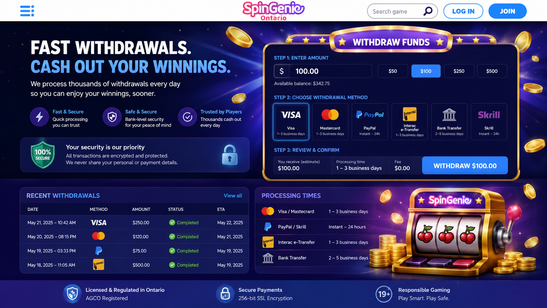
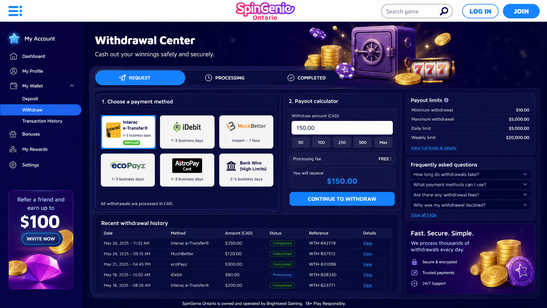
A withdrawal request often looks like one tap, but the actual path has several stages. First, the platform checks whether the account is fully set up and whether any standard verification step is still pending. After that, the request may sit in a review queue before being approved, sent onward, or returned for correction.
Picture someone cashing out late on a Friday night after a few quick slot sessions. From the player side, the request is already done. From the processing side, though, there may still be an internal review, a payment partner handoff, and then a bank or wallet update that only moves during business hours.
Players often mix up approval speed with arrival speed. The first part belongs to the casino workflow. The second part depends on the payment route. When those are separated in your mind, the whole process becomes much easier to read and a lot less frustrating.
Verification Usually Shapes The First Request
The first successful cash-out is often the slowest because it teaches the system who you are. If personal data, address details, or payment ownership need confirmation, the review can expand before funds move anywhere. That is not unusual. It is the point where many accounts switch from fast play mode to full account review mode.
Think of a player who entered one version of a name at registration and a slightly different version on the banking side. Nothing looks dramatic, but the mismatch can still trigger extra checks. Usually, the cleanest move is to review profile details before sending the request, not after the pending status appears.
Payment Method Choice Changes The Feel Of Waiting
Not every route behaves the same. Some methods feel quick once approved because they post almost immediately on the receiving side, while others involve banking timelines that naturally stretch the final arrival. The important part is not chasing the fastest option in theory but choosing a route you can verify and monitor without confusion.
If you use a payment method only because it seemed convenient for a deposit, you may later find it less convenient for cashing out. Many players do this once, then adjust on the next cycle by keeping one clear method for deposits and a matching, trackable method for receiving funds.
Reading Spin Genie Payout Through A Practical Lens
Players tend to focus on one question: is the request moving or stuck? A better way to judge progress is to look at the account signals around the request. Has identity already been confirmed? Was the deposit method previously used without issues? Did the player make the request during a heavy banking period? Those clues tell more than staring at the cashier every ten minutes.
Imagine checking the account three times in one hour and seeing no visible change. That can feel like a problem, but often it only means the request is still inside a normal review stage. What matters is whether the platform asked for action. If no correction is requested, the best response is usually to wait through the standard processing window and keep an eye on messages.
The table below helps separate the steps players can influence from the ones that mostly depend on review order or payment rails.
Stage | What It Usually Means | What The Player Can Do |
|---|---|---|
Request submitted | The cash-out has been placed in the queue | Recheck account details and keep payment access available |
Under review | Standard checks are being completed | Avoid sending duplicate requests unless support advises it |
Approved | The funds have moved beyond internal review | Monitor the chosen method rather than refreshing the cashier |
Returned or paused | Something needs correction or confirmation | Read the notice carefully and fix the exact issue only |
Received | The money has arrived on the selected route | Save a simple record for future cash-out planning |
One small habit helps here: keep screenshots of status messages and the date of the request. Not because something is wrong, but because it gives you a clean timeline if support needs details. Usually, the player who can describe the sequence clearly gets to a solution faster.
Pending And Completed Statuses Mean Different Things
A lot of frustration comes from reading the wrong status. Pending usually means the process is still alive and waiting for a review step, while completed usually means the casino side has finished its part. That does not always mean the funds are already spendable on the receiving side.
Suppose you see completion on the platform but nothing inside the bank account yet. In many cases, that points to the final transfer layer rather than an issue with the request itself. Players who understand this tend to contact support with better questions and avoid unnecessary panic.
Building A Smooth Spin Genie Withdrawal Strategy
The fastest request is often the one prepared before the win happens. That sounds obvious, yet many players skip the boring setup because it feels unrelated to play. In reality, profile accuracy, payment consistency, and document readiness are part of the same strategy as bankroll management.
If you know you may want to cash out after a session, start by checking that the account details match your current documents and payment information. Then look at the available options and choose the one you understand best. A player who keeps the setup simple usually has fewer surprises at the end.
It also helps to avoid making last-minute changes right before a request. Switching payment methods, updating key account data, or trying to split one request into several smaller ones can all add complexity. Sometimes the platform handles that smoothly, but often it creates extra questions that slow the process down.
Another smart move is to request funds at a practical time. A weekday daytime request can feel easier to track than one made during a weekend night, especially if the receiving method depends on bank processing. Players who plan around that difference often report less stress, even when the total timeline is similar.
Finally, stay realistic. The platform can review and release a request, yet the receiving side still has its own pace. When you set expectations around stages instead of one magical deadline, every update makes more sense.
Common Reasons A Request Slows Down
The most common slowdowns are usually not dramatic. A blurred document, an unreadable statement, a mismatch between payment ownership and account name, or a request sent while another financial action is still settling can all create pause points. None of these automatically signal a serious problem, but each one can stretch the timeline.
Imagine sending a cash-out immediately after changing a card or e-wallet setting. The player may see this as a simple update. The system may see it as a moment worth rechecking. That difference in perspective explains why routine changes sometimes lead to extra review.
Weekends, Holidays, And Banking Hours Still Matter
Players often expect digital transfers to ignore the calendar. Sometimes they do. Sometimes they do not. Even if the casino side moves quickly, the receiving path may still lean on business-day timing, public holidays, or the provider's own posting cycle.
If you request funds right before a long weekend in Canada, it is sensible to expect a less predictable arrival window. The best habit here is simple: treat calendar timing as part of your plan, especially when the money is needed for something specific.
Managing Expectations On Mobile And Desktop
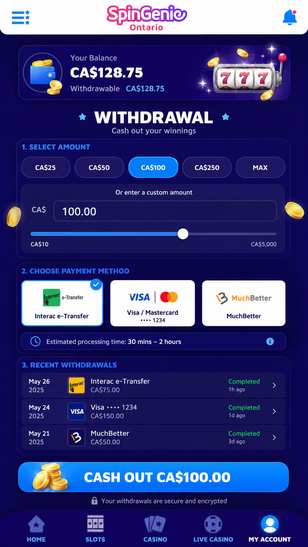
Many users play from a phone, and that changes behavior. People deposit faster, switch games faster, and often request funds while distracted - on a commute, during a break, or late at night. Mobile convenience is great, but it also makes it easier to miss a verification prompt or skim past an important account notice.
Picture a player opening the cashier on mobile with five percent battery left and unstable signal. The request goes through, but a follow-up notice is missed until the next day. The delay feels mysterious, even though the information was available almost immediately. Small mobile habits can create bigger timing problems than players realize.
Desktop use often feels slower, yet it can be better for account review because every detail is easier to read. Uploading documents, checking payment data, and reviewing messages are usually simpler on a larger screen. A practical approach is to play wherever you like, then handle sensitive account steps carefully and without rushing.
Support, Limits, And Responsible Play Tools
A good cash-out experience is not only about timing. It is also about knowing when to contact support and when to use account tools that keep play under control. Adult players in Canada should approach any real-money platform with clear limits, a session plan, and an exit point that is decided before emotions take over.
Imagine a player who sends two or three requests, cancels one, redeposits, and then contacts support in frustration. That kind of sequence can make a simple case harder to read. Usually, the best support message is short, calm, and specific: what was requested, when it was requested, what method was used, and whether any notice appeared.
Responsible play tools matter here too. Deposit limits, cool-off features, and self-exclusion settings are not separate from payment behavior. They shape how players interact with the cashier, how often they chase losses, and whether they are making clear decisions at the moment a request is placed.
Timeout And Self-Exclusion Can Protect Decisions
These tools are most useful before a problem grows, not after. A short break can stop impulse redeposits, while a longer restriction can protect players who notice that emotional play is starting to replace deliberate choices. The point is not punishment. The point is creating distance.
If you have ever felt tempted to cancel a pending cash-out and jump back into games, that is exactly the kind of moment where a break feature becomes practical. Many players think of responsible play tools as something for other people, right until one careful pause saves their balance.